Feeds:
Posts
Comments

Posts Tagged ‘amelo14’

Reflections: Response to “El Tiempo” columns 7: Comentario a Francisco Cajiao: “Educar para la Política”, febrero 17 de 2009.

Debo decir que es casi siempre un verdadero placer leer sus columnas. Su profundo conocimiento de las dinámicas educativas de Colombia es admirable.

Ahora bien, considero que en su columna sobre educación para la política hay varios elementos de gran importancia. Ante las actuales dificultades políticas que vive nuestro país —y las conectadas dificultades éticas y educativas—— usted invita al lector, en parte, a hacer un recorrido histórico hacia los griegos. En este sentido usted, muy prudente y acertadamente, indica que hay al menos dos elementos a considerar. Citándolo directamente dice usted:  1. “La política es el comportamiento fundamental del ciudadano. Política viene de polis (ciudad). Por eso, cuando se habla de competencias ciudadanas es necesario entender que ellas deben conducir a la formación política. …. el ciudadano debe aprender desde su infancia a discriminar lo que conviene para el bien común, de acuerdo con un orden ético y jurídico.”,  y 2. “Siempre, desde la antigua Grecia, se consideró la educación como el medio privilegiado para fortalecer la democracia, formando ciudadanos libres, capaces de discutir sus diferencias y propuestas mediante el ejercicio de la razón. Por esto, el ágora es el espacio privilegiado de la política.”

Al primer elemento le podemos dar el nombre famoso de republicanismo clásico en la medida en que el ser humano según Aristóteles es por naturaleza un ser político. El segundo elemento que usted enfatiza acertadamente es lo que podríamos llamar la importancia de una educación liberal para los griegos. Lo cierto es que en su conjunto estos dos elementos indican una parte de las bases fundamentales de la reflexión filosófica sobre la política que encontramos principalmente en la obra de Aristóteles, que a su vez está respondiendo de manera directa, y también indirecta, a las reflexiones políticas y filosóficas por parte de Platón y su maestro Sócrates. Pero como veremos, estos dos elementos no subsisten de manera tan armónica como podríamos pensar, y sobretodo como podríamos desear, en tanto modernos. Es decir, en tanto modernos nos parecería obvio que, si  logramos dar con el adecuado tipo de educación política, entonces lograríamos llevar o transferir a la realidad esas conclusiones, los resultados de dicha investigación, como base de un proyecto político definitivo de fundamentos universales y generalizables. De esta manera, entonces la práctica y la teoría se retroalimentarían de manera beneficiosa para ambas de tal manera que la justicia se encarnaría como nunca antes. Algo así sí creyó posible todo movimiento marxista/socialista/comunista (y más aún el leninista/stalinista que es modelo aún para las afiebradas FARC) con su consigna de transformación total de la realidad tal y como aparece formulada de manera dramática en las breves y famosas Tesis sobre Feuerbach del propio Marx: (“Tesis 11: Philosophers have hitherto only interpreted the world in various ways; the point is to change it”.)

Pero me temo que semejante proyecto que cree que la educación política puede adquirir real vida y guiar decididamente “desde arriba” (e incluso militarmente) el quehacer político contrasta radicalmente con el verdadero realismo filosófico-político de los grandes pensadores políticos griegos Platón, Jenofonte y Aristóteles (posteriormente complementados por la obra de Cicerón para los romanos). No puedo entrar en detalle aquí, pero por ejemplo, el ejercicio dialógico que presenta La República de Platón, cuyo tema es la pregunta de su interés, es decir, la pregunta por la virtud de la justicia (virtud fundacional de lo político en tanto que nos remite al “bien común”),  invita no a que fundemos una ciudad realmente gobernada por aquellos filósofos políticos o líderes que supuestamente sí han logrado ver el verdadero esquema educativo a seguir, sino todo lo contrario, invita a ver en cierta medida el por qué de las limitaciones profundas y serias de creer que la teoría puede llegar a tener semejantes efectos sobre la realidad política de cualquier ciudad o de cualquier comunidad política. Es más, al comienzo del drama que es este diálogo fundacional entre Sócrates y dos interesantes jóvenes (Glaucón y Adimanto) con intereses políticos diversos, Sócrates mismo es forzado a permanecer en la discusión contra su propia voluntad. Posteriormente en el diálogo Las Leyes Platón retoma de nuevo las intrínsecas limitaciones de lo político comenzando esta vez su investigación desde el lenguaje propio  de lo político. Por ejemplo, los interlocutores son ahora hombres mucho mayores, ya no de Atenas sino de una ciudad extranjera debido a la peligrosa complejidad de las preguntas propuestas, hombres de la “tercera edad” que además deben beber un poco de licor (!) para poder incluso dar arranque al diálogo mismo acerca del complejo rol de las leyes y de lo divino en la fundación de una comunidad política.

Pero incluso, bajo cierta interpretación, también los últimos dos libros de la Política de Aristóteles revelan una posición similar; no hay allí un modelo que podamos simplemente copiar e instaurar en la realidad. Por el contrario, revela esta obra de manera magistral un cierto dualismo claramente jerarquizado indicando, a la vez, tanto la importancia del ámbito político como igualmente las limitaciones inherentes a dicho ámbito humano, limitaciones que sólo se vislumbran desde  la filosofía política  misma. Y una concepción similar ocurre en La República de Cicerón. Además, siglos después, Santo Tomás Moro siguiendo el mismo modelo escribió su Utopía que de nuevo es un ejercicio para percibir los límites de lo político desde el lenguaje de la filosofía política, no un manual de cómo llevar a cabo transformaciones definitivas en la “realidad”.

Esto es lo que se conoce, en el lenguaje de una corriente interpretativa que toma como base la obra de Leo Strauss, como el debate entre el “utopianismo clásico” que se enfrenta decididamente al “idealismo moderno”. Se resume dicho debate, y disculpe que no lo traduzca, de esta manera:

“classical political philosophy  conceives the “best regime” not as an ideal to be realized, nor even something to be approached and worked toward; the elaboration of the best regime is intended, rather, as a subtly playful thought-experiment meant to reveal the limitations of what we can expect from all actual political philosophy” (Pangle, Thomas, Leo Strauss: An  Introduction to his Thought and Intellectual Legacy, p. 46)

Es decir, sea lo que sea que aprendamos de los filósofos políticos griegos, resultará nocivo el no intentar ver sus escritos en sus propios términos. Es más, el pensamiento político clásico es la vacuna precisamente contra el  complejo deseo, por parte de cierto tipo de seres humanos,  de instauración de la justicia total y verdadera en el ámbito real de la política ciudadana. El siglo XX nos dio múltiples ejemplos de los desastres al intentar llevar a cabo cierto tipo de proyecto secular radical a como de lugar (Stalin, Mao, Khmer Rouge,  …. FARC). El periódo del terror bajo Robespierre que se desprende de la Revolución  Francesa de 1789 nos lo revela igualmente. Es decir, el deseo de encarnar un proyecto totalizante de justicia terrenal (piénsese en el resultado de “aplicar” el “Libro Rojo” de Mao para los ciudadanos chinos) , y un cierto deseo inmoderado, violento y hasta tiránico, parecen estar conectados de maneras que el racionalismo político griego nos permite entender mejor. Para estos últimos no puede haber una reconciliación final entre filosofía y política; es más, es gracias a esta fructífera tensión inevitable que garantizamos tanto cierta moderación real en la praxis política, como la creación de unos líderes/ciudadanos hasta cierto punto libres de falsas expectativas y deseos destructivos con respecto a un cierto ordenamiento legal que ellos encarnan y del cual descienden. Como usted lo pone: “el ciudadano debe aprender desde su infancia a discriminar lo que conviene para el bien común, de acuerdo con un orden ético y jurídico.” Pero además esta valiosa tensión “garantiza” la aparición en escena de aquellos individuos filosóficamente preparados en la tradición clásica que puedan generar interpretativamente dos proyectos diferentes, a saber,  la más profunda explicitación de las bases que fundamentan un proyecto político dado (piénsese por ejemplo en el valor que los straussianos le dan a los “Founding Fathers” de los Estados Unidos),  explicitación que a la vez  les permite de esta manera poder juzgar sana y prudencialmente —– al igual que criticar seriamente—— los progresos y/o retrocesos del ordenamiento mismo desde su fundación.  Un ejemplo de dicha postura dual sería el entrar a considerar críticamente la Constitución del 91 más allá de una simple defensa progresista. (more…)
Read Full Post »

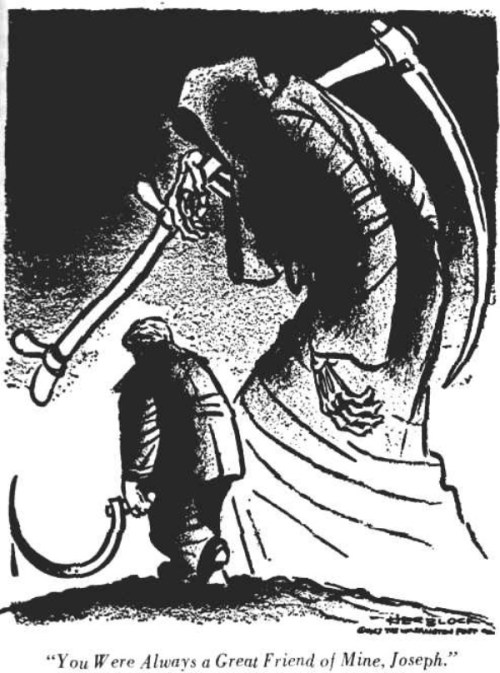
Response to “El Tiempo” columns 6: Comentario a Enrique Santos Calderón: “Canje sin arandelas: ¿mucho pedir?” Febrero 15 de 2009.

Usted dice:‘Cano’ es un tipo inteligente, con sardónico sentido del humor, pero forrado en una impenetrable coraza estalinista.”

herblock16

Jamás imaginé ——en pleno siglo XXI—— que se utilizaran las palabras ‘inteligente‘, ‘cómico’ y ‘estalinista’ en una misma frase.  Más allá de todo interés estratégico como lo fue el de Churchill, y con lo que ahora sabemos de la dictadura estalinista, ¿no resulta aberrante siquiera llegar a preguntarse algo así como,  “¿será que Stalin fue un “tipo inteligente”? ¿No es esto confundir lo que es inteligencia y sabiduría práctica (phronesis) con lo que es astucia pervertida y unas prácticas fundadas en acciones deplorables que justifican cualquier medio para cualquier fin? ¿No es esto confundir lo que es el sano humor de la autocrítica con el  sórdido cinismo de la  absolutez tiránica? Porque es en parte precisamente en la capacidad para reir que se revela nuestra capacidad para la libertad.

El que no se vea que esto es fundamentalmente inaceptable resulta seriamente preocupante para nosotros que creemos en cierto tipo de moderación y hace cada vez más imposible ——-irónicamente todo lo contrario a lo que pide su columna——–  una resolución seria al conflicto. Moderación, sí; moderación a cualquier precio, no. Canje sí, canje a cualquier precio, no.

______________

La columna de Enrique Santos Calderón: “Canje sin arandelas: ¿mucho pedir?”, Febrero 15 de 2009, dice así:

“Salida en falso la del presidente Uribe al calificar de “bloque intelectual” de las Farc al Comité de Colombianos por la Paz que ha intercambiado cartas con el sucesor de ‘Tirofijo’. Es macartismo primario, que desdice del jefe del Estado y les otorga a las Farc un estatus que ni tienen ni se merecen.

Ya quisiera ‘Alfonso Cano’ tener a su lado a un bloque de intelectuales. El prontuario de las Farc los ha espantado a todos, y hoy no conozco a un solo colombiano pensante que avale tan larga trayectoria criminal. Otra cosa es que muchísimos ciudadanos anhelen la paz, crean en el “intercambio humanitario” o piensen que las últimas liberaciones abrirían la puerta a una solución negociada del conflicto armado. Objetivos deseables pero -como están las cosas- aún lejanos. No por ello se los puede tachar de cómplices de la guerrilla.

La reciente matanza de indígenas awás (¿17, 27?) en Nariño -asesinados con arma blanca dizque por “colaboradores del Ejército”- borra a machetazo limpio la imagen buscada por las Farc con las liberaciones unilaterales de la semana pasada. ¿Acción inconsulta de un frente aislado en el fragor de la guerra? Es posible. Solo falta entonces que la condenen de manera inequívoca. Y aun así, este acto brutal reafirma la ya tal vez irredimible deshumanización a que ha llevado a las Farc su perversa estrategia de “combinación de las formas de lucha”.

Cartas amables a Piedad y liberaciones unilaterales, acompañadas de secuestros, bombas en las ciudades y masacres en la selva son una aberración que el país rechaza con la contundencia que demostró hace un año, en la más grande movilización ciudadana que haya producido Colombia en su historia. Pero esto parece resbalarles.

Existía la esperanza de que, tras el 4 de febrero, los golpes sufridos y la asunción del ex universitario Guillermo Sáenz a la cúpula, las Farc iniciarían algún replanteamiento de sus prácticas y concepciones. Vana ilusión, si nos atenemos al único pronunciamiento de fondo de ‘Alfonso Cano’ desde que asumió la comandancia (extensa entrevista en ‘Cuadernos para el diálogo’, 04-12-08), donde no expresa el menor remordimiento, ni la más leve autocrítica. Según el nuevo vocero del Secretariado, las Farc están ahí: inmodificables e incólumes, incontaminadas por el narcotráfico y aferradas a la lucha armada. Deprimente, pero cierto.

Llegué a pensar que alguna evolución visible produciría la llegada de ‘Cano’, con quien he hablado dos veces en mi vida. La primera hace 22 años, en tiempos de los diálogos en Casa Verde, y luego en el 2001, durante el despeje del Caguán, cuando me invitó a confrontar opiniones en su cambuche cerca de San Vicente. Discutimos más de ocho horas sin parar (sus segundos, ‘Pablo Catatumbo’ e ‘Iván Ríos’, quedaron tendidos del sueño) y fue muy poco lo que avanzamos. ‘Cano’ es un tipo inteligente, con sardónico sentido del humor, pero forrado en una impenetrable coraza estalinista.

En cualquier caso, las liberaciones que ordenó son un gesto unilateral de las Farc que se debe valorar. La desgracia cíclica de nuestro infernal conflicto es que cuando se presenta algún hecho constructivo, no pasa un día sin que se produzcan otros que lo anulen: la matanza de los awás, la exigencia de ‘Cano’ de incluir a ‘Trinidad’ y ‘Sonia’ en el intercambio, el progresivo endurecimiento de Uribe tras su positiva reacción inicial a las liberaciones…

Lo deseable, en fin, sería un canje simple y sobrio de los 24 uniformados aún en poder de las Farc por guerrilleros presos en Colombia. Expedito, sin trampas, shows, ni condiciones irreales de parte y parte. El Gobierno, que no debe alimentar falsos triunfalismos con las Farc, está en deuda con estos soldados y policías que han sufrido lo indecible. Y las Farc aún tienen que demostrar, con menos engaños y más hechos, un propósito de paz. Mientras tanto, en las mismas.”

Read Full Post »

Reflections: Leo Strauss on moderation and the extremisms of Colombia

As one regards the politics of  extremism  ——–both in word and in action—– which guide the reality of our Colombia (whose most grotesque example is ANNCOL), one cannot but hold firm to the words with which Strauss brings to a close his “Liberal Education and Responsibility”:

“We must not expect that liberal education can ever become universal education. It will always remain the obligation and the privilege of a minority. Nor can we expect that the liberally educated will become a political power in their own right. For we cannot  expect that liberal education will lead all who benefit from it to understand their civic responsibility in the same way or to agree politically. Karl Marx, the father of Communism, and Friedrich Nietzsche, the stepgrandfather of fascism, were liberally educated on a level to which we cannot even hope to aspire. But perhaps one can say  that their grandiose failures makes it easier for us who have experienced those failures to understand again the old saying that wisdom cannot be separated from moderation and hence to understand that wisdom requires unhesitating loyalty to a descent constitution and even to the cause of constitutionalism. Moderation will protect us against the twin dangers of visionary expectations from politics and unmanly contempt for politics. Thus it may again become true that all liberally educated men will be politically moderate men. It is in this way that the  liberally  educated may again receive a hearing even in the market place (note: in the sense of ‘agora’).” (Liberalism Ancient and Modern,  p. 24)

Those extremists of the word who mock our president as if the presidency were simply a man and not one of  the foundational institutions of our democratic stability (for who will not feel entitled to mock the presidency now, no matter who holds it? no matter if for the right reasons?), those extremists who defend in silence and in word the practice of kidnapping of civilians by the corrupt and savage FARC who just this week killed aboriginals with total disregard for justice, decency, courage  and nobility (deaf as deaf can be to the, now very old,  news of Marx’s overwhelming failure), those extremists who because of their “sacrifices” claim that they alone are the ones who truly love their country, those extremists who might be tempted by the appeals of endless tyranny,  those extremists who have left Colombia and forsaken her to whatever future, those extremists of the intelligence that do not even know of the “market place” of which Strauss speaks above, those extremists who will find any way to defend and rationalize the growth and commercialization of narcotics (for legalizing an activity without a foundational long-standing education towards the common good seems utterly dangerous)  and specially those extremists —specifically those who have given the honor and privileges of being called “officers” of the nation—- that hold that recklessly using the force of the state against its own citizens by bypassing the laws of the country and bringing shame to the very foundations of our important military institutions is a possibility; all these extremists of the mind and of the heart  should take to heart Strauss’s words. For if not, Colombia’s chance for history, nay, Colombia’s chance for recognizable recovery and truthful admiration, might be lost to time.

Ironically, Colombia seems to need a new kind of politics; the politics of intelligent and firm moderation —–not to be confused with a politics of the extremism of  tolerance for we DO NOT TOLERATE, specially inhumane, senseless and cowardly kidnappings (as our courageous President Uribe does not tire of arguing), but also extra-judicial assassinations by those whose apparent self-righteousness is simply a disguise for their self-aggrandizement and recognition at whatever cost.

Such is the politics towards which  the reading of Strauss, and his contemporary student Thomas Pangle, leads. But such a reality can only come about through liberal education, and the above quote reveals some of the dilemmas inherent in this type of education. Be that as it may, our country lacks a liberal education which “may again receive a hearing even in the market place (note: in the sense of ‘agora’).

Read Full Post »

This content is password-protected. To view it, please enter the password below.

Read Full Post »

Reflections: Socrates and Xenophon, the philosophic and the political life

At the very least, this is clear. The most fundamental difference between Socrates and Xenophon might be dangerously summarized by saying that Socrates, who rarely felt the need to physically leave Athens, never wished to rule over anyone under any circumstances, while Xenophon —–his questioning and nowadays seldom read student—– did in fact wish to rule over many under varying circumstances (see Buzzetti).

Or, to put it much more nobly and perhaps more truthfully: it would be best to say that the once unknown and adventure-loving Xenophon —–who had come into direct contact with Socrates—– suddenly came to recognize far outside the boundaries of his native Athens not only the unavoidability of ruling among humans, but also and perhaps much more importantly, his absolutely unique capacity for such ruling when true crisis touched upon his life and those surrounding him. However, later in life he seems to have given up this politically engaged desire for the desire to recollect in writing both tension-ridden forms of life: on the one hand recovering the life of Socrates in his Memorabilia and the other  truly amazing shorter Socratic texts, and on the other hand recovering the circumstances of his rise to fame and glory as a commander in his autobiographical The Anabasis of Cyrus. In contrast, Socrates also never felt the desire to write, not of himself or others.

Agoristic philosophy ——as the foundation of political philosophy—– begins in wonder (thaumazein) at such striking complex connections and deep tensions between the life of politics and the life of philosophy. Its path is that of an understanding of the dynamics of virtue(s); its guide remains Aristotle.


*****************

Appendixes

Xenophon only appears in direct conversation with Socrates in two short sections, one in his Memorabilia where he listens to Socrates’ views on kissing(!), the other in his The Anabasis of Cyrus where he recalls the conversation with Socrates with which he began his voyage. These astonishing sections read as follows:

Appendix 1: (Memorabilia I, 4; Bonnette translation)

“These were the sort of things he used to say with playfulness accompanied by seriousness.  On the other hand, he advised that one steadfastly refrain from sex with those who are beautiful. For he said that it is not easy when one touches these sorts to be moderate. In fact, after he perceived once that Critobulus the son of Crito had kissed the beautiful son of Alcibiades, he asked Xenophon in Critobulus’ presence”

“Tell me, Xenophon,” he said, “ didn’t you hold Critobulus to be one of the moderate rather than the rash human beings, and one of these with forethought rather than senseless and reckless?”

“Certainly,” said Xenophon.

“Well, hold now that he is hotheaded and heedless in the extreme. He would even make somersaults into daggers and leap into fire.”

“And what did you see him doing,” said Xenophon, “that you have formed such judgments about him?”

“Did he not dare to kiss the son of Alcibiades, who is most fair and in his bloom?” he said.

“But if that is the reckless deed,” said Xenophon,”in my opinion, I, too, would endure this risk.”

“You wretch!” said Socrates. “And what do you think you would suffer after kissing  someone so beautiful? Would you not immediately be a slave rather than free, spend a lot of harmful pleasures, be in great want of leisure for attending to anything noble and good, and be compelled to take seriously what even madman would not take seriously?”

“Heracles!” said Xenophon. “What terrible power you ascribe to a kiss.”

“And do you wonder at this?” said Socrates. “Don’t you know that poisonous spiders not even half an obol in size crush human beings with pain and drive them from their senses  merely by touching them in their mouths?”

“Yes, by Zeus!” said Xenophon, “For spiders inject something through their sting.”

“You fool!” said Socrates. “Do you think that when those who are beautiful kiss they don’t inject anything, just because you don’t see it? Don’t you know that this beast that they call beautiful in bloom is so much more terrible than spiders that, while spiders inject  something when they touch, it (even when it does not touch, but if one just looks at it) injects even from quite far away something of the sort to drive one mad? And perhaps ‘lovers’ are called ‘archers’ because those who are beautiful inflict wounds even from afar. But I counsel you, Xenophon, whenever you see someone beautiful, to flee without looking back .”

Appendix 2: (The Anabasis of Cyrus III, 1, 4; Ambler translation )

“In the army there was a certain Xenophon, an Athenian, who followed along even though he was neither a general nor a captain nor a soldier; but Proxenus, a guest-friend of his from long ago, had sent for him to come home. He promised that if he came, he would make him a friend of Cyrus, whom Proxenus himself had said he believed to be the better for himself than his fatherland was. So Xenophon, on reading his letter, took common counsel with Socrates the Athenian about the journey. And Socrates, suspecting that becoming a friend of Cyrus might bring an accusation from the city, because Cyrus had seemed eager in joining the Lacedaemonians in making war against the Athenians, advised Xenophon to go to Delphi and take common counsel with the god about the journey. Xenophon went and asked Apollo to which one of the gods he should sacrifice and pray in order to make the journey he had in mind in the noblest and best way and, after faring well, to return safely. And Apollo indicated to him the gods to whom he needed to sacrifice.

When he came back again, he told the oracular response to Socrates. On hearing it, Socrates blamed him because  he did not first ask whether it was more advisable for him  to make the journey or to remain, but he himself had judged that he was to go and then inquired how he might go in the noblest way. “However, since you did ask it in this way,” he said, “you must do all that the god bade.”

So after sacrificing to the ones the god had indicated, Xenophon sailed off.”

Read Full Post »

This content is password-protected. To view it, please enter the password below.

Read Full Post »

Three biblical stories, two in the Old Testament ——specifically in Genesis—— and one in the New Testament, might aid us in trying to understand, however imperfectly and sketchily, the issue of brotherhood in the Bible. The first story is the well-known story of Cain and Abel; the second, the well-known story of Joseph; and finally, the third story, the well-known story of the parable by Jesus of the Lost Son. All three will be presented solely by way of puzzles and questions. In this regard we ask hesitantly: Could it be that the possibility of friendship according to the Bible is very limited in the case of brothers for some very precise reasons? But, why would this be so? Don’t citizen parents actually put all their conjoined strengths into bringing up their children to be good to each other, to love each other?

Story 1: Cain and Abel, Genesis 4

Why provide a second fall immediately following the most foundational of all falls by Adam and Eve? Why indeed are the primary models of brotherhood Cain and Abel? Why is the story so astonishingly short? Why did God not accept Cain’s offering even if it was the first? Why is Cain so wronged and upset by God’s not accepting his gift? Is it because he is the first born? But, what is it that the first born feels entitled to that feeds such angry responses? Moreover, why does he seek to kill his brother? Why not simply punch him a few times? What is the nature of such blinding rage? What is the fundamental importance of Abel’s being a “keeper of flocks” as against Cain’s being “a tiller of the ground”? Is there something about nomadic lives that is more akin to the nature of the divine? Would it be its greater independence from the earthly? Or is it that nomads are much more in need of the presence of the divine as they move around a “homeless” world? Does it have to do with the fact the Abel deals with animals and their care? But then again, why can’t Cain see that God himself actually speaks to him in the story and not to Abel? In the same vein, why is the story about Cain and much less about Abel? Why does it matter so little to know what Abel’s life was like? And furthermore, why does Cain lie to make things even worse? But if Cain knows he is a sinner, and the worst at that as a fratricidal kind of being, why continue to punish Cain with a permanent eternal sign that will mark him permanently to all on the earth? Why punish him beyond his own consciousness of his knowing he has done a terrible, spiritually self-destructive, deed? (See Appendix 1 below.) And dramatically for political philosophy as defended by Athens, why is Cain the one who actually founds the first city of the Bible, the city of Enoch? Why is the Bible so pessimistic about the political from the very start?

Story 2: Joseph, Genesis 37-50

Why is the love of Joseph by his father so connected to the varicolored tunic he gave him in his old age? Does this shed light into the relation of the beautiful and the divine? Why is it also so intimately connected to his actually accompanying his father in old age as the younger one? Does this shed some light into the commandment regarding the honoring of our parents? Is honoring our parents primarily being able to accompany and prepare them for death? But if so, wouldn’t believers also learn much from Socrates for whom philosophy is a constant preparation for dying? And, why does the Bible see it fit to show that now it is not only one brother, but many, who hate Joseph? Moreover, why does Joseph so naively express such complex dreams to his brothers? Didn’t he surmise he would be in trouble? Must faith be necessarily naive (see Ricoeur’s Freud and Philosophy)? And besides, what is so special about dreams and our connection to the divine in the Bible? How to contrast these presence with Aristotle’s own consideration in his prudential text on dreams? And his brothers, why can’t they appreciate Joseph’s honesty? Would they have rather Joseph not tell them anything at all, that is, not prepare them at all for God’s presence? And very polemically, does Joseph’s being selected by God shed some light on our modern democratic families? And still, why in this occasion do the brothers decide only to fake Joseph’s death? Is it because they are thinking of their father with a certain sympathy? Surely not, for their father would still think Joseph to be dead, wouldn’t he? What is so particularly appalling about Judah’s idea of selling and wreaking profit from his brother’s enslavement? What is it about our desire to have and posses material things than makes Judah lead his own family into utter dislike by God? His future generations, the creations of his creations, are somehow condemned by his avarice, aren’t they? Is this part of the basis as well for Aquinas’ powerful condemnation of usury which speaks little to us nowadays? And what precisely could anger brothers and sisters about one of their own actually being chosen by God? Why wouldn’t this be an occasion for joy? What are brothers particularly so much in competition about? Could it be that at the bottom of their hearts lies a desire to become god-like and to be recognized as such by their kin? Wouldn’t this be what Aristophanes tells us as well in the Symposium? And moving closer to our times, why did Thomas Mann rewrite the story of Joseph in so many pages in our modern context of war? And very importantly, perhaps most importantly, how to understand Joseph’s final words to his fearing brothers:

“But Joseph said to them, “do not be afraid, for am I in God’s place? And as for you, you meant evil against me, but God meant it for good in order to bring about this present result, to preserve many people alive. So therefore do not be afraid: I will provide for you and your little ones” So he comforted them and spoke kindly to them” (Genesis, 50: 20-21)

What exactly does Joseph mean by saying that God “meant it for good”? Was Joseph at all times aware that things would end so? Wouldn’t one apply the words “all ‘s well that ends well “ here? Is this last question simply a reflection of one’s pride? And why does he not suffer as much as Job does? What is it about Joseph that gives him such strength?

Story 3: Parable of the Lost Son, Luke 15: 11-32

Why does this parable follow the parables of the lost sheep and the lost coin? Why are they so ordered? Why one must speak of losing oneself in parables? Is it because we are moving in a particular direction? And crucially, why does the lost son wish to become a migrant risking his own life? Is it because he is more like Abel than Cain, the tiller of the land? Why wish to get lost? For surely, we know what is at stake in leaving our families, don’t we? And once again, why does the brother get so angry? Why is the love of his own recognition so important to him if he has lived right beside his father all his life? Wasn’t that enough? What more could he be looking for? And again, who would be envious of one’s brother’s having suffered and despaired in solitude? Which of these two brothers would actually be better prepared to honor his parents, as is our duty according to the 10 Commandments? Would the adequate honoring of one’s parents be a compromise between the two? But wouldn’t such a compromise involve a certain strange kind of anger that is not to be seen in the noblest of honorings and loves?

__________________
Appendix 1:

For a much more developed puzzling presentation of the Bible, one can turn to Professor Thomas Pangle’s difficult, yet engaging and puzzle-creating, Political Philosophy and the God of Abraham where he touches on the life of Abraham and the sacrifice of his son Isaac. In particular, see pages 93-96 ‘The Puzzle of Divine Foreknowledge” which are three complete pages made up only of puzzles and questions. Or later on, in the chapter on “Guilt and Punishment” where Pangle writes in crucial relation to the above questions:

“But this last formulation brings close to us a final troubling question. However we are to understand criminal responsibility, what are the intelligible grounds for the overwhelming conviction that the guilty deserve to suffer for what they have done; and what are the intelligible grounds for the concomitant hope that they –that even we ourselves— will suffer the punishment that they, and we, deserve. For guilt betokens sin or vice; and sin or vice are either genuinely and severely harmful, in the most important respect, to the very soul of the criminal; or else they betoken an alienation of the criminal from the source of meaning for him as a being designed to devotion. Why, then, is it appropriate, why is it sensible, that such a crippled and or alienated being receive, in addition to and as a consequence of his corruption or alienation, further harm or suffering. Why is it so terribly important for us that to the suffering and mutilation of the spirit that is entailed in being unjust there be added extrinsic bad consequences for the perpetrator?” (PPGA, p. 101)

Pangle keeps alive, in critical contrast to modernity, the enriching yet tense debate between Athens and Jerusalem.

Appendix 2:

For a striking story of how Socrates views, at least minimally, the relation between brothers see Memorabilia 2.3 where one finds an astonishing conversation with Chaerecrates who has fought with his older brother. To begin to even try to understand this story, one would have to reconsider what Socrates considered to be a philosophical life and its relation to the citizens who inhabit the agora. Without such a perspective, the story seems merely to involve a strange naivety. And we know for certain that Xenophon, a general, was anything but naive.

But perhaps the true nature of brotherhood is best exemplified in The Republic where Glaucon and Adeimantus —both Plato’s brothers— encounter Socrates dialogically on the question of justice and reveal dramatically to the reader their unique and differing characteristics as regards the political and philosophical life. Perhaps it is by looking at the question of justice that at least some healthier brotherhoods may come about.

Read Full Post »

secuestrados_by_amelo14.jpg

This is simply a translation of Ingrid Betancourt’s letter to her mother. It was published today in El Tiempo newspaper of Bogotá. Why translate it? Because I know many do not speak Spanish and therefore the audience of her intimate and powerful letter can be increased by seeking more English-speaking readers. Others who know other languages may translate it for others, as well as place their translation within their blogs. Perhaps this will bring more attention to our plight as Colombians, and perhaps the prayers of more and more will give her —and all the other secuestrados— the necessary strength to live through her/their ordeal. Betancourt was kidnapped by the infamous FARC in 2002 and only recently was a video released which showed she was still alive. For her biography see: here . The letter itself in Spanish is here.

(Note: I translate it as I am an official translator both in Canada and in Colombia; But MUCH more importantly because I feel deeply for those who remain kidnapped in our dear Colombia. For my constant interest see some very basic tributes here and here. )

“We live dead here.”

“This is a difficult moment for me. They ask for proofs of survival and here I am writing this letter in which I spill my soul unto paper. I am physically in bad shape. I have not kept on eating, my appetite has left me, my hair falls off in great quantities.

I have lost the desire for everything. I think that that is the only thing that is right, I desire nothing because here in the jungle the answer to everything is no”. It is best, then, not to want anything so that one can at least free oneself from one’s desires. I have been asking for an encyclopedic dictionary to read something, to learn something, to keep intellectual curiosity going. I keep on waiting that perhaps out of compassion they will provide me with one, but it is best not to think about that.

From there on anything else is a miracle, even listening to you in the mornings because the radio I have is too old and broken down.

I want to ask you, dear mother, to tell the children that I want them to send three messages per week (…) nothing transcendental, but anything they can and which they can imagine … I need nothing more, but I need to be in contact with them, the rest does not matter anymore. (…)

As I said to you before, life here is not life, it is just a terrible waste of time. I live or merely survive in an hammock hanging from two posts, covered by a mosquito net and with a tent on top which serves as a roof. With this I can say I have a house.

I have a cabinet where I place my equipment, that is to say, my backpack with my clothes and the Bible which is my sole luxury. Everything ready if one has to start to run. Here nothing is one’s own, here nothing lasts. The only constant thing is uncertainty and precariousness. Any moment they can give the order to pack and to sleep in any hole, lying anywhere with any animal (…) my hands sweat and my mind becomes clouded and I end up doing things two times more slowly. Hikes are a torture because my equipment is too heavy and I can’t carry it (…) but everything is stressful, my things are lost or taken away, like the blue-jean that Mela had given me for Christmas, the one with which they caught me. The only thing I have been able to save is my jacket; that has been a blessing, because the nights are freezing cold and I have had nothing else to cover myself with.

Before I used to enjoy each bath in the river. As I am the only woman of the group, I had to bathe practically with all my clothes on; shorts, bra, t-shirt, boots. Before I used to like to swim in the river, today I do not even have the strength for that. I am weak and cold, I look like a cat approaching water. I, who have loved water so much, cannot even recognize myself. (…) But ever since they separated the groups, I have not had the energy for anything. I stretch a bit because stress blocks my neck and it hurts a lot.

With the stretching exercises, the split and others, I manage to alleviate the tension in my neck (…) I try to keep quiet, I speak very little so as to try to avoid problems. The presence of a woman amongst so many prisoners who have been held in captivity for 8 to 10 years is a problem (…) When one is searched they take away the things one loves the most. A letter that arrived from you they took away after the last proof of survival in 2003. The drawings by Natasha and Stanis, the photos of Mela and Loli, the prayer necklace of my father, a governing programme with 190 points; everything they took away. Everyday there is less of me left. Some details Pinchao has told you. Everything is tough.

It is important that you dedicate these lines to those people who are my oxygen and my life. Those who keep my head above the water, which help me not to drown in forgetfulness, in nothingness and in despair. They are you, my children, Astrica and my little ones, Fab, aunt Nancy and Juangui.

Everyday I am in contact with God, Jesus and the Virgin (…) here everything has two faces, happiness comes around and then pain. Happiness here is sad. Love alleviates but opens new injuries … it is to live and die again. For years I could not think about the children and the pain of my father’s death was almost the last straw. I cried thinking about them, I felt I was asphyxiating, that I could not breathe. I said to myself: “Fab is there, he is taking care of everything, you must not think about it nor think.” I almost went crazy with the death of my father. I never knew how it happened, who was there, if he left a message, a letter, a blessing. But that which has calmed this torment is to know that he left us trusting in God and that I will hug him there. Of that I am sure. Feeling your strength has been my strength. I never saw messages until I was united with Lucho, Luis Eladio Pérez, on the 22 of August 2003. We were true friends and were separated in August. But throughout all that time he was my shoulder, my shield and my brother. (…).

I carry with time the memory of the age of each of my children. Each birthday I sing their Happy Birthday. I always ask them to allow me to bake a cake. But for the last three years the reply has always been no. Nonetheless, if they bring a cookie or any rice or bean soup, which is usually what happens, I imagine it to be a cake and I celebrate their birthday in my heart.

To my Melelinga (Melanie); my spring sunshine, my princess from the constellation of the swan, to her whom I adore so much, I want to tell you that I am the proudest mother on earth (…) and if I had to die to day I would leave my life thanking God for my children. I am very happy with her Masters in NY. That is exactly what I would have advised (…) But take note, it is very important that she do her DOCTORATE. In the world today, even to breathe one must have credentials (…) I will not tire of insisting to Loli (Lorenzo) and Mela that they not stop until they have obtained their PhD . I wish Mela would promise me with that. (…).

I have always told you that you are the best, much better than I am, something like the best version of what I would like to be. That is why, with the experience that I have accumulated through life, I ask you my life to prepare yourself in order to reach the top.

To my Lorenzo, my Loli Pop, my angel of light, my king of blue waters, my head musician who sings and enchants me, the owner of my heart, I want to tell him that from the day of his birth up to today he has been a fountain of joy. Everything that comes from him soothes my soul. Everything comforts me, everything gives me peace. (…) I could finally hear his voice a few times this year. I trembled with emotion. It is the voice of my Loli, the voice of my boy, but there is another man now over the voice of my little boy. A deep voice of a real man, like that of my father (…)

Your life awaits you all, try to reach as high as possible, to learn is to grow, not only because of what one learns intellectually, but also because of the human experience, the people surrounding you which provides emotional sustenance to have greater control over oneself each day, and spiritually, to mold a greater character of service towards others, where ego is reduced to its most minimal expression and one grows in humility and moral fortitude. One goes with the other. That is to live, to grow up to serve. (…)

To my dearest Sebastian, my little prince of stellar and ancestral voyages. So much that I want to say to him! First, that I do not want to leave this world before he has the knowledge, the certainty and the confirmation that there are not 2, but 3 children of my soul (…) But for him I will have to un-knot years of silence which weigh upon me much since captivity. I have decided that my favourite colour is the blue of his eyes (…) Just in case I do not leave this place, I write it down so that you can keep it in your soul, m cherished Babon, and so that you might understand, that I understood when your brothers were born, and it is that I have always loved you as the son that you are and that God gave me. The rest are only formalities. .

I know that Fab has suffered because of me (…) Tell Fab that in him I rest, over his shoulders I cry, in him I lean so that can continue smiling out of sadness, his love makes me strong. Because he is there for the necessities of my children, I can cease breathing without life hurting so much (…)

To my Astrica, so many things that I do not know where to begin. Perhaps to tell her that her “little resume” saved me during the first year I was kidnapped, during the year in which I grieved for my father. (…) I need to talk to her about all these moments and to hug her and cry until I run clear out of tears in my body. In everything that I do she is there as a reference. I always think, “We did that with Astrid when we were small” or “Astrid did this better than I did” (…) I have heard her several times on radio. I feel great admiration for her impeccable manner of expression, for the quality of her reflections, for the control over her emotions, for the elegance of her sentiments. I hear her and think: “I want to be like that.” (…) I imagine how they enjoy things with Anastasia and Stanis (Ingrid’s niece and nephew) . How it hurt me that they took away their drawings. The poem by Anastasia read: “through a lucky touch, through a magical touch or a touch by God, in three years or three days you will be again with us.” And the drawing by Stanis was a rescue through helicopters, I sleeping in a confined space (caleta) just like the ones here, and he was my Saviour.

Mom, there are so many people to thank for remembering us, for not abandoning us. For a long time we have been like the leppars who make every dance an ugly event, us captives are not a “politically correct” topic, it is much better to say that one has to be strong with the guerrillas without sacrificing some human lives. Before these ideas, silence. Only time can open consciousness and elevate the spirit. I think about the grandeur of the United States, for example. That greatness is not due to the richness of lands or raw materials, etc., but the result of the spiritual greatness of the leaders who molded their Nation. When Lincoln defended the right to life and liberty of the enslaved blacks of America, he also confronted many Floridas and Praderas…. But Lincoln won and there remained impressed in the collective of that country the priority of human life over any other interest.

In Colombia we still have to think where we come from, who we are and where we want to head. I wish one day we will feel that thirst fro grandeur which allows peoples to surge from nothing to the very sun. When we will be much less conditional towards the defense of the life and the liberty of those who are ours, that is to say, when we are less individualistic and more solidarious, less indifferent and more committed, less intolerant and more compassionate. Then, that day, we will be that great country we all wish we were. That greatness is lying asleep in our hearts. But our hearts have hardened and they weigh so much they do not allow for higher sentiments. But there are a lot of people I wish to thank because they are contributing to awaken the spirit and grandeur of Colombia…

For many years I have thought than as long as I am alive, as long as I keep on breathing, I must always keep hope. I no longer have the same strength, it is much more difficult for me to believe, but I wanted you to feel that what you all have done has made the difference. We have felt human (…) Dear mother, I still would have many other things to tell you. Explain to you that for a long time I have not had news from Clara and her baby (…) Alright, mommy. God help us, guide us, give us patience and embrace us. Forever and ever.”


__________________________________________

The original letter in Spanish reads; (more…)

Read Full Post »

Horses 1

Some time has passed since my father’s untimely death. Since then an epitaph has been chosen to be placed near his resting place deep inside a uniquely beautiful natural area within the Andean mountains of our dear Colombia. Surrounded by the nature he loved, he will surely rest in peace. The epitaph chosen, translated into English reads something like this: ”We will always have you in our hearts.” My mother, who spent most of her life beside him even when separated, approved those words. This alone speaks of their great importance.

Although this is quite a nice and simple epitaph, and in fact shows the importance of remembering the love one carries within for those who depart, I think it has some limitations. Perhaps by looking at its limitations we can become more aware of what an epitaph is for and what are the hidden possibilities within for diverse epitaphs. Maybe then we will be better prepared to engage in the reflective process which is behind the selection of those epitaphs with which we will honor the passing through life of those close to us. Perhaps it will even allow us to set out what epitaph will appear above our very own gravestones someday.

The three limitations to this epitaph are as follows: 1. it speaks more of “us” than the person who has died, namely, our father (it says “we” and “our hearts”, instead of “him” and “his heart”); 2. it is the kind of epitaph that could be placed in many tombs, so that the particularity and uniqueness of my father (and he was quite unique, I tell you!) is quite lost, and finally, 3. it tries to convince us that the aim of an epitaph is to touch our emotions primarily and only secondarily our capacity for reflection and creative imagination which are among the highest faculties we possess as human beings. In contrast, I think an epitaph should: 1. speak primarily about the person him/herself who has died, 2. reveal him or her in a special light using the expressive power of language, and finally, 3. should not primarily focus on the emotions, specially if these have not been articulated in the life of the members of these families, but should point towards reflection and the need we have of such reflection in order to guarantee a certain true and honest legacy of the person who has died. How could one come up with such an epitaph?

First off, by looking at the many famous ones which many others have used to remind us of those who were found to be memorable. One can in turn try to relate some of them to the close loved person who has died. In the case of my father two such realms come to mind. On the one hand, the serious type of epitaphs which are usually used for those who have dedicated their lives to the political or public life. The single most famous example of this type of epitaph can be seen in the words found at Thermopylae, words recently beautifully and powerfully recovered in the movie the 300:

“Go tell the Spartans, stranger passing by
that here, obedient to their law, we lie.”

At the very least these soldiers asked of their kin not to forget the sacrifice they endured in order to try to secure the lawful freedom of those intimately close they left behind. Another such powerful example of an epitaph that in its simplicity touches us like few can, is the one found at the “Tomb of the Unknown Soldier”. It reads: “Here Rests In Honored Glory An American Soldier Known But To God.” Its power lies precisely in that usually we bury those who are known to us, here the words remind us that many die in anonymity. This epitaph stands against the injustice of such anonymous deaths.

A second realm which could apply to my father would be a more ironic and fun-spirited one. Usually it is artists who have the strength to come up with such kinds of epitaphs. Given my father’s unique sense of humor, one could eventually think of an epitaph such as one which Hemingway once proposed and which reads:

“Pardon me for not getting up”

My father would have laughed.

In this respect, by letting ourselves be touched by what others have decided to lay down as their final resting words ——those few limited marks which will attempt to break us free from our mortal demise and now obvious finitude—— we would be more able to decide which words to choose for those we love and even for ourselves upon, better yet, before (!) our departure. (more…)

Read Full Post »

T and Ω: a critical stance on our dangerous desire for overspecialization

I have written elsewhere on the deep need that our overspecialized western societies —–which find themselves in a serious ecological crisis, in confusion regarding the question of the divine and in the presence of multiple deep political tensions—– have for T-type kind of people. I myself am part of those few who try to consider themselves “T-minded” individuals. My resume is a “T-kind” of resume. Although this post intended to show both some of the obstacles for the actual generation of T-minded people, as well as some of the essential and more deeply clarified characteristics of such individuals and their complex narratives, the length itself of these reflections has limited me in this post to a more basic goal. This post will merely reflect and puzzle as to why the letter T might be both the best and the worst candidate to graphically represent what I have called “T-minded people” are all about. Subsequent posts will hopefully deal with the very important issues regarding the obstacles themselves which T-people face given their decision both to be seriously critical of overspecialization and its blind, powerful and utilitarian defenders, and also to fight the generalized and very real obstacles which make the creation of reflective-oriented T-people in our hyper-specialized societies almost, and tragically so, impossible. Our reflective path here will lead us from the letter T to the Greek letter omega (Ω). Both letters, as you will see, may provide the graphical basis for a serious critical stance on our dangerous desire for overspecialization.

Classical liberal education stands as a counterweight to such overspecialization. This can even be seen in the way we educate our bodies. Physical education has become an option for those who want to “specialize” in it. In contrast, the classical practice of a liberal education had a central physical component in the area of “physical education”; it was a very important part of a more holistic understanding of what it means to be fully human. Now, in several highly-specialized countries, this “education” appears as an optional goal given our radical tendency to over-specialize our children. This is a tendency for which we are paying the price in terms of our children’s very own physical and mental health. What is the over-specialized society’s solution? Well, seek a health specialist! And moving from specialization to specialization we move farther and farther from another type of understanding of things, a healthier and a happier (in the Aristotelian sense) mode of being. In contrast, a liberally educated society sees that a “physical education program is designed to cultivate physical fitness, basic athletic skills, and an appreciation of the value of recreational physical activity”. Link

What holistic “physical education” allows is an education in moderation as well as in the beauty of the whole. It also prepares the mind for play and the value of leisurely activity. Over-specialization is founded upon a certain immoderation and the partialized beauty of dissection. One could even go so far as to say that overspecialization rarely knows of leisure, for it must constantly seek further specialization in order to gain the upper hand. Its endless desires know of little rest. Many modern athletes, with their dramatic stories of excess pressure and unwise decisions, are a prime example of such differences. Professional cycling, as in the Tour de France,is only one of many such examples. Our athletes are, regrettably,no longer liberally educated.

In a similar vein, it is Aristotle ——a T-type philosopher—- who expresses beautifully this kind of awareness in the culminating reflections as they appear in the Politics. These reflections can be seen as the most developed words on what are the very foundations of a truly liberal education. For instance, there he writes concerning the best possible education regarding drawing as it relates to generating the conditions for a free and virtuous citizenry:

“Similarly they should be educated in drawing not so that they may not make errors in their private purchases and avoid being deceived in the buying and selling of wares, but rather because it makes them experts at studying the beauty connected with bodies. To seek everywhere the element of utility is least of all fitting for those who are magnanimous and free.” (Aristotle Politics VIII *3, 11138a40-1338b3)

For if there is to be specialization, as there must be, it must be of a very different kind. Drawing and learning to see the beauty of our bodily condition go hand-in-hand for Aristotle. Seeing beauty and becoming a nobler and freer type of citizen also go hand-in-hand. In contrast,for us overspecialization goes hand-in-hand with increased utility; the more you specialize the more “you’ll get out of it”. Just think of the way our athletes are recruited nowadays. Or just ask your family doctor. We have thus lost view of a different form of magnanimity and public freedom which stands as a powerful and necessary corrective. And to such type of Aristotelian drawing we shall try to return when looking at the way we draw in our minds the letter T, letter which stands against such dangerous and self-destructive tendencies towards overspecialization.

Or put another way. Shaw is said to have said: “More and more, we know more of less; until there will come a time when we will know much of nothing, and nothing of the whole.” Our informational age gathers and reproduces very specialized know-how endlessly; just think of the hundreds of blogs posted daily on the web. And one hears, first condition for your blog to be successful and be read by many, specialize it! Or think of the important yet endless publications on the most minute issues which are disconnected from all other types of understanding. Our age specializes in specialization. We are knowers indeed; and yet,paused reflection on the serious limitations surrounding this kind of specialized and self-reproductive knowing is mostly lacking. So much so, that of our age it is perhaps true to say that because it sees only the trees it fails to see the forest. In fact, to see the trees without seeing the forest is certainly what has endangered our dwelling in this our planet currently in critical ecological indeterminacy. In contrast, T-minded people seek to see the forest and traverse the changing paths of the forest to have a clearer grasp, if ever incomplete, of the whole. T-people are forest dwellers, rather than merely tree analyzers. Murdered nun Dorothy Stang, who sought to protect Brazil’s rainforest,was one such forest dweller. And if they in fact decide to “analyze” trees, which T-people can, then they do so with a different grounding, a grounding in the poetic. I have looked at one such form of analysis here: Link

But let us return to our privileged letter, the letter T. Why use this letter as a mode of self-understanding? Please look carefully at the letter itself:

T

Nothing special, right? We know it and know how to use it.

But I must stop. I am truly sorry for so many delays. We haven’t even started, and yet we already encounter our first puzzle. Why? Precisely because I believe only “T”-minded kind of people will actually seek to stop,see and reflect on the letter itself beyond its utility. I might be very wrong, but I think few ofus have actually looked at the letters we use in our daily lives as the pragmatic specialists that we are. We simply use such letters to write, to speak, to designate, to express. Such letters are not ends-in-themselves, they are simply means to other human things and goals. But, what if what is deeply required of us in our “never-ending progressivist age”, were reflection on the basics themselves? We have become so accustomed to using these letters that we have forgotten that once they did not play a central role in our self-understanding as humans. What I mean is, in part, something like this.

Anne Carson’s beautiful Eros the Bittersweet, a short and poetic study of the Greek alphabet in connection to the erotic poems of Sappho and the dialogues in which Socrates’ life is portrayed,recalls how an illiterate man reported seeing some strange figures which for the literate were obviously letters. But he himself could not recognize ——let alone understand—– them as they were foreign to his self-understanding. Here is what the illiterate man, that same one who abounds in our developing countries,reports:

“I am not skilled at letters but I will explain the shapes

and clear symbols to you.

There is a circle marked out as it were with a compass

And it has a clear sign in the middle.

The second one is first of all two strokes

And then another one keeping them apart in the

middle.

The third is curly like a lock of hair

And the fourth is one line going straight up

And three crosswise ones attached to it

The fifth is not easy to describe:

There are two strokes which run together from

separate points

To one support.

And the last one is like the third.“ (Carson, pp. 57-58)

And Carson goes on to “solve” the riddle which for us literate ones is no riddle at all: “The man has spelled out the six letters of the name Theseus: ΘΗΣΕΥΣ (note: letters in Greek)”.And that is not all, this is a fragment of a tragedy which Euripides himself entitled with the very same letters, the tragedy whose name is Theseus. (Have you ever thought about the letters of YOUR name? Do you remember how difficult it was to actually learn to write it down? How much satisfaction accompanied this act! Have you ever seen your name written down in another language and felt the overwhelming surprise?) Describing them so, we recall that each letter goes beyond its function, each has a form and a unique beauty. A letter hides a mystery, one such letter is “curly like a beautiful lock of hair”. Letters can be ends-in-themselves, even in their simplicity. (I have argued something similar for prepositions here , and for basic lines here )

And we come to realize as well, that uniqueness is not universally shared. So much so that we marvel at the form underpinning the drawing of this Arabic letter: ى .. Do you see its curvy beauty? Do you see its elongated bird-like being? Or else, I once tried to learn Hebrew (the things one does for love!), and I recall I had to see, among many others, this Hebrew letter: ש. I am indeed prejudiced as I have come to love lines given my decision to become a T-oriented person myself; but can you see the perceptual possibilities here? Can you see the musicality, the natural growth, the candle-like presence, the ascending spirituality? Can we for one moment be surprised as the illiterate man was? Can we still learn to draw as Aristotle bids, namely, in wonderment? Or are we immune to such surprises given that we cannot get hold of our own global ignorance given our radical knowledge in what are only individual, localized, self-enclosed and disconnected realms? (more…)

Read Full Post »

« Newer Posts - Older Posts »